The Ultimate Guide: Procurement vs Purchasing Management
TL;DR – Procurement vs Purchasing
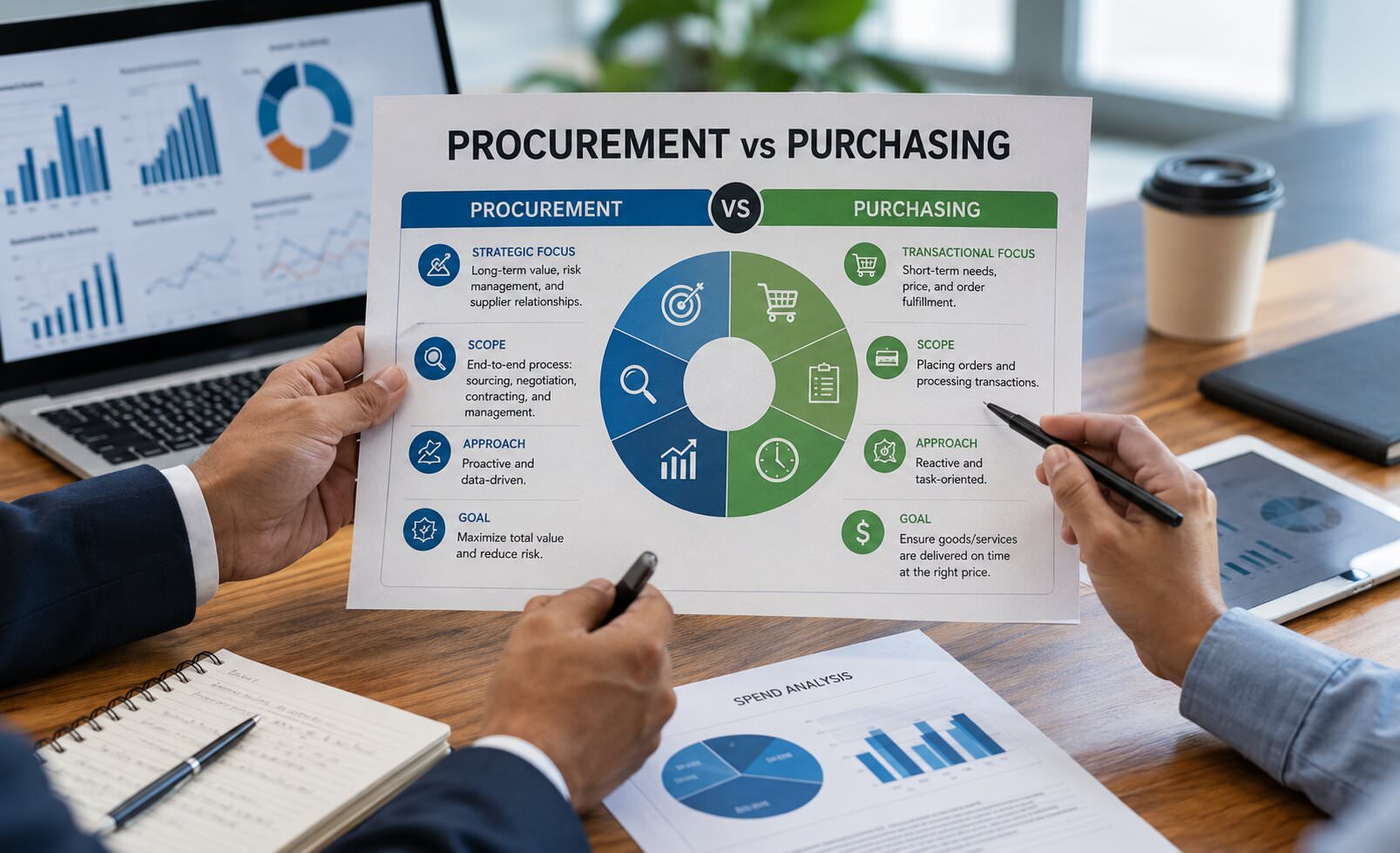
While often used interchangeably, procurement vs purchasing represent two distinct functions within an enterprise. Purchasing is the tactical, transactional process of ordering goods and services, heavily focused on cost and efficiency. In contrast, procurement is the overarching, strategic function that encompasses sourcing, supplier management in procurement, contract management, and mitigating risk to secure goods that align with long-term corporate goals. Understanding the procurement vs purchasing difference is critical for optimizing your supply chain management and implementing the right procurement management software.
1. Introduction: Demystifying the Procurement vs Purchasing Debate
In the vast landscape of supply chain management, terms are often tossed around casually. Among the most confused pairs are procurement and purchasing. If you ask a layperson, they might tell you that both words mean “buying things for a business.” However, for supply chain professionals, CFOs, and operations leaders, understanding the nuanced procurement vs purchasing difference is a matter of strategic survival and operational efficiency.
As organizations grow, the complexity of acquiring goods, services, software, and raw materials expands exponentially. What begins as simple purchasing management transforms into complex procurement and supply chain management. This comprehensive guide is designed to be the definitive resource on this topic. Whether you are aiming to become a senior procurement manager, exploring procurement vs purchasing examples, or looking for the best procurement software for order and invoice management 2025, this guide covers every facet of the industry.
2. Part 1: Defining Purchasing Management
To understand the difference between procurement and purchasing, we must first isolate and define purchasing.
What is Purchasing?
The core purchasing manager definition revolves around the transactional phase of buying. Purchasing is the specific, actionable process of how goods and services are ordered. It is tactical, reactive, and highly focused on cost and quantity. When an organization needs office supplies, raw materials for a factory, or a subscription to purchasing and inventory management software, the purchasing department executes the transaction.
The Tactical Purchasing Cycle
The standard purchasing cycle typically includes the following sequential steps:
- Purchase Requisition: An internal department requests an item.
- Purchase Order (PO) Creation: The purchasing team generates a formal PO.
- Order Fulfillment: The supplier receives the PO and ships the goods.
- Goods Receipt: The business receives the goods and logs them into their purchasing and inventory management software.
- Invoice Processing & Payment: The invoice is matched with the PO and receipt (three-way matching) and paid.
The Role of the Purchasing Manager
A purchasing manager (or purchasing commodity manager) is responsible for ensuring that the purchasing cycle runs without friction. A typical purchasing manager job description includes duties such as monitoring inventory levels, processing purchase requisitions, ensuring deliveries meet quality specifications (which involves quality control purchasing and inventory management), and resolving invoice discrepancies.
The salary for purchasing manager roles varies by industry, but an average salary for purchasing manager typically ranges from $70,000 to $100,000 annually, depending on whether they hold credentials like a cpm certified purchasing manager certification.
3. Part 2: Defining Procurement Management
If purchasing is the act of buying, what is procurement management? To define procurement management, we must look at the broader strategic picture.
What is Procurement Management?
The meaning of procurement management encompasses all activities involved in acquiring goods and services, from the initial identification of a need to the final disposal of the asset. It is a proactive, strategic, and relational process. Procurement management in supply chain management involves sourcing, vetting suppliers, negotiating terms, managing contracts, mitigating risks, and continuously analyzing the market.
The End-to-End Procurement Process
A robust procurement management plan includes steps far beyond just issuing a PO:
- Needs Identification & Spend Analysis: Analyzing procurement spend management data to identify enterprise-wide needs.
- Sourcing Strategy: Deciding whether to make or buy, and identifying potential supplier pools globally.
- Supplier Evaluation: Using ai-powered procurement solutions for supplier risk management to vet vendors.
- Negotiation and Contracting: Engaging in procurement contract management to lock in favorable terms, SLAs, and prices.
- Supplier Relationship Management (SRM): Fostering long-term partnerships, vital for strategic procurement management.
The Role of the Procurement Manager
A procurement manager looks at the big picture. When evaluating procurement vs purchasing definition through roles, the procurement manager job duties are heavily analytical and strategic. A senior procurement manager might oversee millions in corporate spend. Key responsibilities in a procurement manager job description include developing a category management procurement strategy, implementing procurement risk management strategies, and overseeing procurement and contract management.
A sr procurement manager salary can easily exceed $130,000 to $160,000+, especially in specialized fields like engineering procurement and construction management or healthcare group purchasing organizations population health management.
4. The Ultimate Breakdown: Procurement vs Purchasing Difference
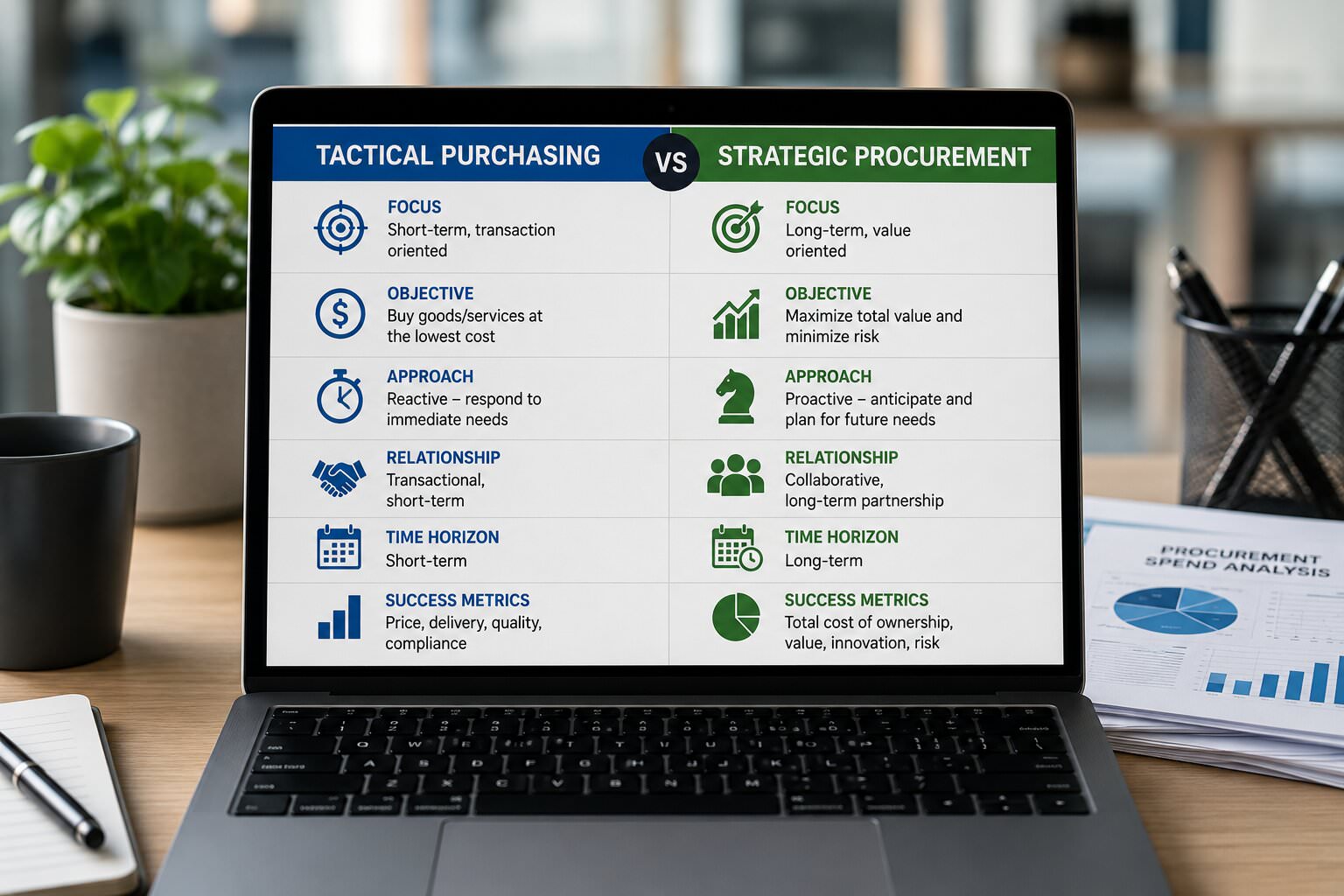
Let us draw a clear line in the sand regarding the procurement vs purchasing difference. While they operate on the same continuum, their focus areas are fundamentally different.
| Criteria | Purchasing | Procurement |
|---|---|---|
| Definition | Transactional execution of buying goods/services. | Strategic sourcing, negotiation, and acquisition process. |
| Focus | Price, cost, and immediate transaction efficiency. | Total Cost of Ownership (TCO), value creation, risk mitigation. |
| Approach | Reactive (responding to internal requests). | Proactive (forecasting needs, analyzing markets). |
| Relationship | Transactional (often one-off or short-term). | Relational (building long-term supplier partnerships). |
| Scope | Subset of Procurement. | Encompasses Purchasing; integral to supply chain management. |
Procurement vs Purchasing Examples
The Purchasing Approach: An IT manager needs 10 laptops. They tell the purchasing specialist. The specialist finds a retailer selling them for $1,000 each, creates a PO for $10,000, buys them, and processes the invoice. The goal is fulfilled quickly and cheaply for that specific transaction.
The Procurement Approach: The procurement operations manager analyzes the company’s growth plan and realizes they will need 500 laptops over the next two years. They engage in strategic procurement category management (IT Hardware). They run an RFP, evaluate vendors based on sustainability (sustainable procurement management), warranty, and bulk pricing. They negotiate a three-year contract directly with the manufacturer for $800 per laptop. Here, the procurement manager added strategic value, reduced long-term risk, and saved money.
5. Advanced Strategies: Category, Contract, and Risk Management
When asking what is category management in procurement, one is stepping into advanced supply chain strategies. Category management in procurement is the process of grouping similar goods or services into “categories” and managing them as discrete business units to drive value. By utilizing procurement category management software, negotiators have greater leverage and deeper market intelligence.
Contract and Risk Management
What is contract management in procurement? It is the continuous lifecycle management of vendor contracts. The importance of contract management in procurement cannot be overstated. A poorly managed contract leads to value leakage and compliance failures. The procurement contract management process includes drafting, negotiating, executing, and auditing via procurement contract management software.
Global supply chains are fragile. Procurement risk management involves identifying and mitigating risks that could disrupt supply. Effective procurement risk management strategies address financial risks, geopolitical shifts, operational disasters, and reputational hazards.
6. The Technological Revolution: Procurement Software in 2025
We cannot discuss procurement operations management without diving deep into technology. Today’s procurement management platform landscape is driven by automation, AI, and Big Data. Procurement spend management is the practice of analyzing where every dollar goes. Tools like the coupa procurement spend management platform or ivalua company overview fintech procure-to-pay spend management provide unparalleled visibility.
The Rise of Generative AI
The latest frontier is Artificial Intelligence. Solutions like generative ai procurement catalog management software and ml procurement catalog management software solution are transforming how internal users buy. Instead of browsing clunky static catalogs, employees interact with AI chatbots to find approved supplies.
7. The Purchasing Managers’ Index (PMI)
No ultimate guide to purchasing would be complete without exploring macroeconomic indicators. What does purchasing managers index mean? The Purchasing Managers’ Index (PMI) is an economic indicator derived from monthly surveys of private sector companies. It measures the prevailing direction of economic trends in the manufacturing and service sectors.
Key metrics include the ISM Manufacturing Purchasing Managers Index (the standard for the US economy), the Services Purchasing Managers Index, and the China Manufacturing Purchasing Managers Index. When the purchasing managers index today drops significantly, a proactive procurement manager knows to prepare for supply chain slowdowns.
8. Conclusion: Moving from Purchasing to Procurement Excellence
In summary, the procurement vs purchasing debate is not about which is better; it is about understanding their unique functions within a successful enterprise. Purchasing management is the engine that keeps daily operations running, while procurement management is the navigation system charting the strategic course.
For organizations looking toward 2025, transitioning from a reactive purchasing mindset to a proactive, strategic procurement operations management culture is a competitive necessity. By embracing deep category management in procurement, stringent risk oversight, and cutting-edge generative ai procurement savings project management software, businesses transform their supply chains into sources of strategic advantage.
Frequently Asked Questions (FAQ)
- Q: What is the main difference between procurement and purchasing?
A: Procurement is the strategic, end-to-end process of sourcing, negotiating, and managing contracts, whereas purchasing is the tactical, transactional act of ordering and paying for goods. - Q: Does a small business need both a procurement manager and a purchasing
manager?
A: Usually, no. In smaller organizations, a single purchasing manager might handle both tactical buying and some strategic vendor negotiation. As a company scales, the roles separate. - Q: Are certifications important for a purchasing manager?
A: Yes. Earning a certified purchasing manager (CPM) certification significantly boosts your salary range for purchasing manager and validates your expertise in purchasing and supply management.