MRP vs ERP: Key Differences, Systems & Software Guide 2026
TL;DR – MRP vs ERP Systems
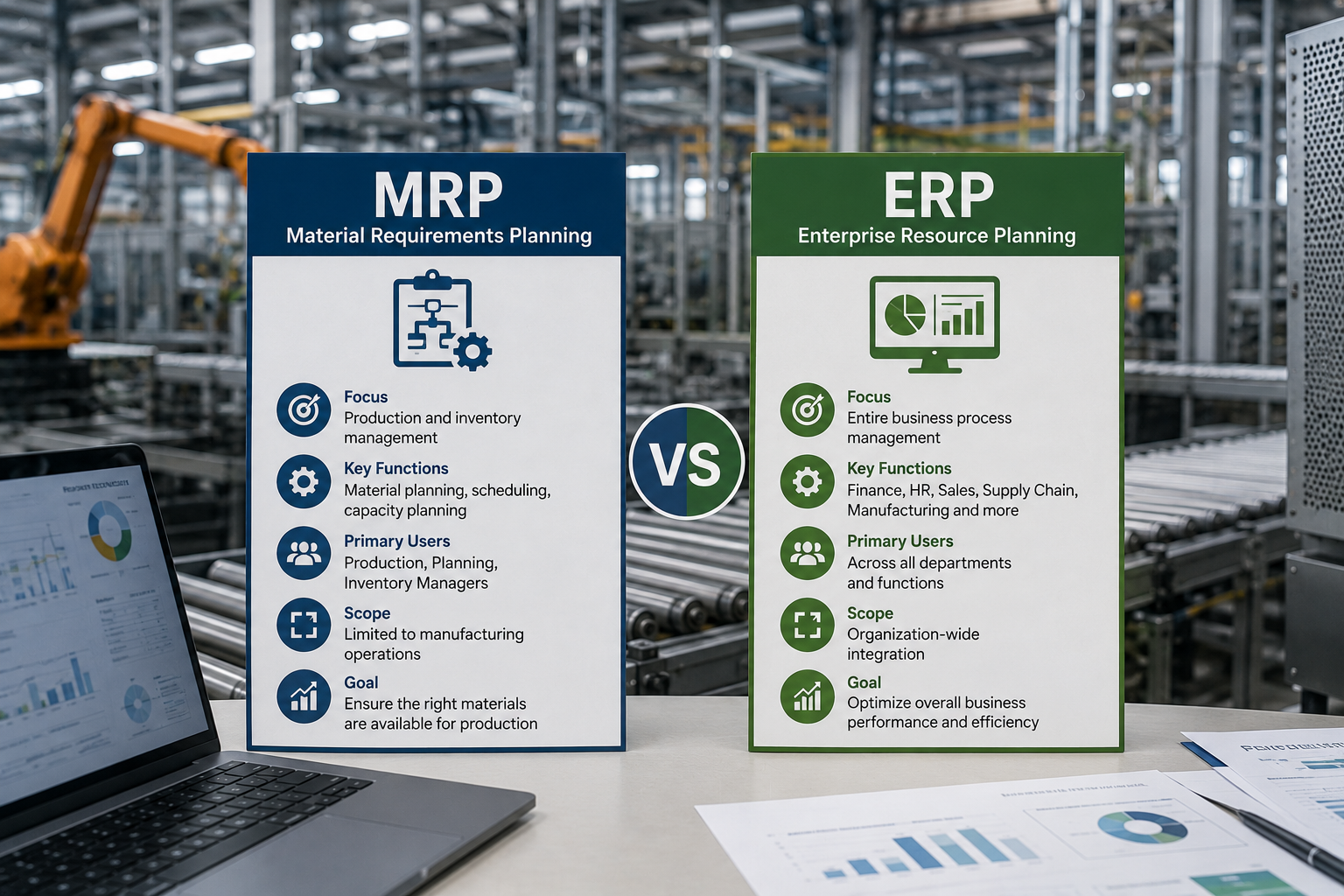
If you are struggling with erp vs mrp, the easiest way to understand it is scope. What is an MRP? MRP (Material Requirements Planning) is a specialized system used strictly for manufacturing production planning, inventory control, and scheduling. It answers three questions: What is needed? How much is needed? When is it needed? On the other hand, ERP (Enterprise Resource Planning) is an overarching business management platform that includes MRP software but also handles finance, HR, sales, and procurement. The mrp system vs erp system debate comes down to whether you just need to manage the shop floor (MRP) or run the entire company through a unified database (ERP).
1. Introduction: The Evolution of Manufacturing Software
In the high-stakes world of industrial production, managing inventory and schedules is the difference between profitability and bankruptcy. The debate surrounding mrp vs erp has existed for decades, evolving as technology has advanced from mainframe computers to cloud based mrp software. Many business owners ask, “what is mrp vs erp, and which one does my factory actually need?”
Whether you are comparing sap erp vs mrp, looking for the best mrp software for small business, or trying to understand erp vs mrp vs mes, this comprehensive 5000+ word guide will serve as your ultimate resource. We will explore the mrp vs erp difference, unpack the mrp acronym, dive into mrp vs mrp ii vs erp, and help you select the right erp/mrp system for your enterprise.
2. Deep Dive: What is MRP? (Material Requirements Planning)
Before we can compare the two, we must establish a concrete mrp definition. What does MRP stand for? In the context of manufacturing, MRP stands for Material Requirements Planning. The meaning of mrp revolves entirely around production planning and inventory control.
The Core Function of an MRP System
A true mrp planning system is designed to calculate exactly what materials are required to manufacture a product, how many of those materials are needed, and when they must be ordered to meet customer demand without creating excess inventory. MRP material requirement planning is the heartbeat of a production facility.
How MRP Works: The Inputs and Outputs
To operate, an mrp system software requires three critical inputs:
- Master Production Schedule (MPS): What are we making and when? (This addresses mrp vs erp in supporting master production schedule).
- Bill of Materials (BOM): Exactly what parts, assemblies, and raw materials make up the final product?
- Inventory Status File: What mrp stock do we currently have on hand, and what is already on order?
The output of mrp is: A detailed production schedule and purchasing recommendations (often generating an erp vs mrp po or Purchase Order request) to ensure materials arrive exactly when the assembly line needs them. This is often referred to as closed loop mrp when feedback from the factory floor is fed back into the planning system.
Key Benefits of MRP Software
Implementing manufacturing mrp software (such as katana mrp, fishbowl mrp, or an as400 mrp system) provides immense benefits:
- Optimized mrp inventory levels (reducing holding costs).
- Improved mrp scheduling for shop floor workers.
- Reduction in stockouts, ensuring the mrp production planning cycle never halts.
3. The Evolution: MRP vs MRP II
If you have researched erp vs mrp systems, you have likely stumbled upon the terms mrp 2 or mrp ii. Understanding the difference between mrp and mrp2 is crucial to understanding how modern ERPs were born.
What is MRP II? (Manufacturing Resource Planning)
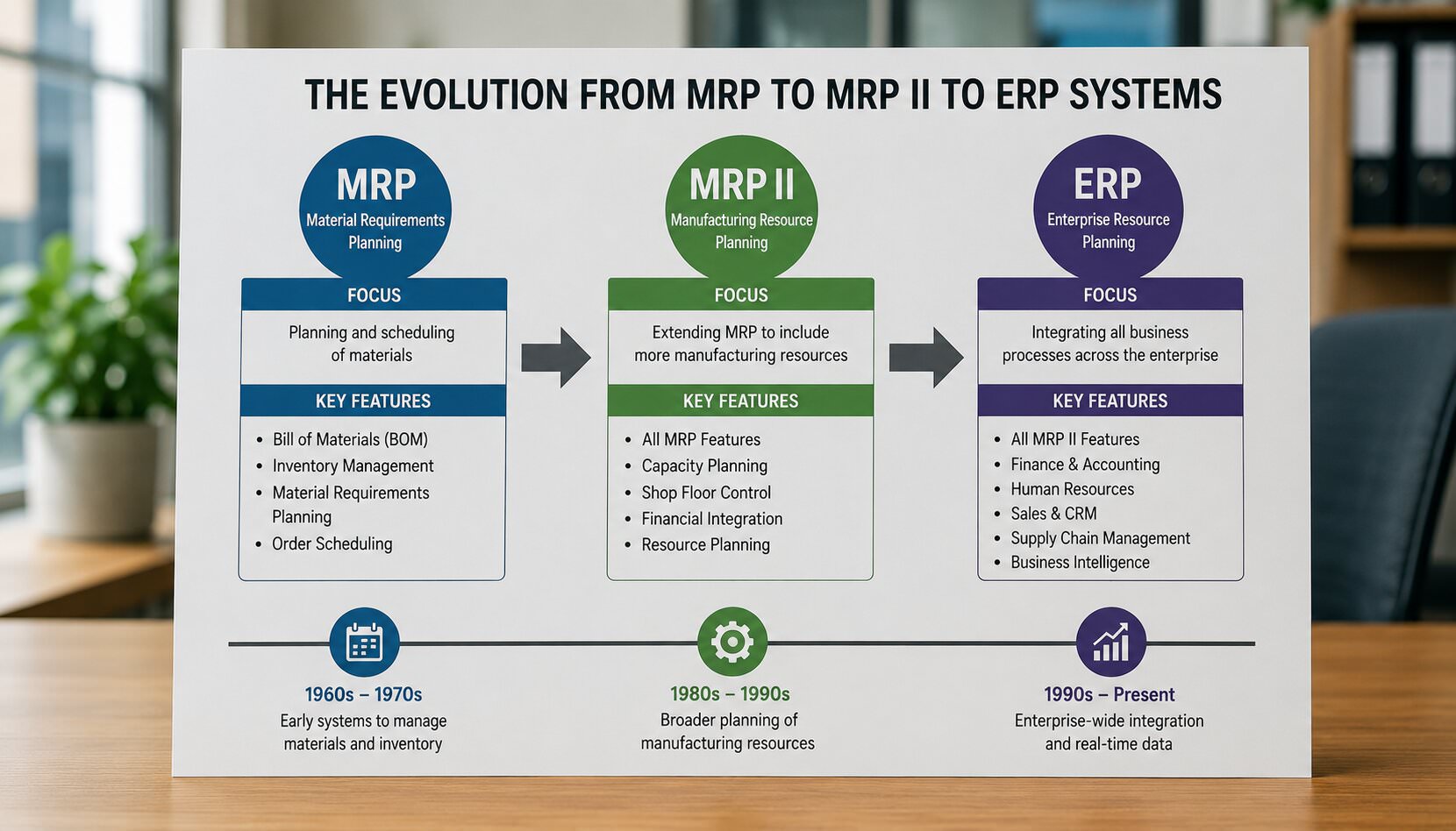
While MRP I focused strictly on materials (inventory and BOMs), manufacturing resource planning mrp ii expanded the scope to include other manufacturing resources. MRP II software integrates capacity planning, machine scheduling, labor routing, and basic financial accounting related to the factory.
When comparing mrp vs mrp 2 vs erp, think of it as an evolutionary timeline:
MRP I managed the parts.
MRP II managed the parts, the machines, and the factory workers.
ERP manages the entire business.
4. Deep Dive: What is ERP? (Enterprise Resource Planning)
To grasp the erp mrp meaning, we must define ERP. Enterprise Resource Planning (ERP) is a massive software ecosystem designed to manage all core business processes in real-time, facilitated by software and technology. Unlike an mrp system, which is confined to the factory floor, an ERP system touches every desk in the company.
ERP vs MRP Software: The Scope of ERP
An ERP system includes an mrp module (hence the term erp/mrp system), but it also contains:
- Financial Management & Accounting: General ledger, accounts payable/receivable, and payroll.
- Human Resources (HR): Employee tracking, benefits, and timecards.
- Customer Relationship Management (CRM): Sales pipelines and customer data.
- Supply Chain Management (SCM): Logistics, warehousing, and vendor portals.
When someone asks, “what is erp and mrp?”, the simplest answer is that MRP is a specific tool, while ERP is the entire toolbox.
5. The Ultimate Comparison: MRP System vs ERP System
The mrp system vs erp system: unveiling the key differences comes down to integration, users, and cost. Let’s look at the erp vs mrp definition comparison.
| Feature / Criteria | MRP (Material Requirements Planning) | ERP (Enterprise Resource Planning) |
|---|---|---|
| Primary Users | Production Managers, MRP Planners, MRP Controllers, Inventory Clerks. | C-Suite, Finance, HR, Sales, Procurement, and Manufacturing. |
| Core Focus | Manufacturing efficiency, inventory optimization, and production scheduling. | Overall business efficiency, data siloing elimination, and financial reporting. |
| Scope of Integration | Limited to the factory floor, BOMs, and raw material suppliers. | Extends MRP to the entire supply chain, integrating front-office and back-office. |
| Complexity & Cost | Lower cost, faster to implement (e.g., mrp software for small business). | High cost, complex implementation (e.g., sap erp vs mrp). |
| Examples | Katana MRP, Fishbowl MRP, MRP Easy. | SAP, Oracle, Epicor ERP, Microsoft Dynamics. |
Analogy: The Engine vs. The Car
If your business is a car, the MRP system is the engine—it focuses on raw materials (fuel) and output (horsepower). The ERP system is the entire vehicle, including the engine (MRP), the dashboard (Analytics), the climate control (HR), and the navigation system (CRM).
6. Advanced Integrations: ERP vs MRP vs MES
To complicate matters, enterprise manufacturers often discuss erp vs mrp vs mes. What is MES?
MES (Manufacturing Execution System) is the software that physically controls the machines on the shop floor. While an mrp schedule tells you what to make today, the MES actually monitors the robotic arms, tracks the mrp barcode scans, and records defects in real-time.
- ERP: “We received a customer order for 500 bikes. Finance approved the credit.”
- MRP: “We need to order 1000 wheels and schedule production for Tuesday.”
- MES: “Machine 4 is currently assembling bike #42, operating at 98% efficiency.”
7. The Modern Era: Cloud MRP, DDMRP, and SAP
The landscape of mrp solutions is rapidly changing. In 2025, cloud-based mrp software dominates the market. Systems like Odoo MRP, NetSuite MRP, and Katana MRP software offer mrp software with integrated inventory management accessible from any browser.
Demand Driven MRP (DDMRP)
Traditional MRP relies on accurate forecasting, which is often flawed. The industry is moving towards demand driven mrp (DDMRP). The ddmrp vs traditional mrp debate centers on strategic inventory buffers. Instead of forecasting, demand driven mrp software reacts to actual daily sales orders, preventing the “bullwhip effect” in the supply chain.
Enterprise Solutions: SAP and Epicor
For large corporations, standalone MRPs are rare. Instead, they use the mrp planning in sap or epicor mrp system. What is mrp in sap? It is a deeply embedded module (often referred to as mrp sap b1 or mrp type in sap) that runs complex algorithms overnight to generate procurement proposals across global facilities.
8. How to Choose: MRP or ERP?
The decision between mrp or erp depends on the size and complexity of your business. Best mrp software for small business implementations (like easy mrp or quickbooks mrp integrations) are perfect for startups that just need to get their mrp inventory under control without overhauling their accounting software.
However, if your business is experiencing rapid growth, struggling with data entry duplication between accounting and production, or needing advanced financial reporting, then upgrading from a standalone mrp to erp is a necessary step. You need a unified erp/mrp software architecture.
9. Frequently Asked Questions & Disambiguations
Because the mrp abbreviation is just three letters, people often search for “what does mrp mean” and find conflicting results. Here are the most common questions and alternate definitions.
- Q: What is the main difference between ERP and MRP?
A: MRP handles manufacturing and inventory; ERP handles the entire business (including MRP functions). - Q: What is MRP in Economics? (MRP Econ)
A: Outside of manufacturing, mrp economics definition stands for Marginal Revenue Product. The mrp formula finance calculates the additional revenue generated by adding one unit of a resource (like a new employee). - Q: What is MRP in Retail / India?
A: In countries like India, an india mrp label or mrp sticker with barcode stands for Maximum Retail Price. Consumers often ask “is gst included in mrp in india?” (Yes, it is). - Q: What is MRP in Baseball?
A: The mrp meaning baseball refers to a Middle Relief Pitcher. - Q: What does the Military Relocation Professional (MRP) Certification entail?
A: The military relocation professional mrp certification is a real estate designation (realtor mrp) for agents helping military personnel relocate. - Q: Are there hardware products called MRP?
A: Yes! It is a common model number. Examples include the alpine mrp m500, alpine mrp-f300 amplifier, lmt mrp upper (Lewis Machine and Tool firearms), and mrp bike forks/suspensions. (Note: These are completely unrelated to manufacturing software).