The Ultimate Guide: Batch Manufacturing vs Discrete Manufacturing
TL;DR (Too Long; Didn’t Read)
Understanding the distinction between batch manufacturing vs discrete manufacturing is critical for optimizing operations. Discrete manufacturing involves assembling distinct, countable items (like cars or computers) using a Bill of Materials (BOM). These products can usually be disassembled back to their basic components. On the other hand, batch manufacturing and process manufacturing rely on manufacturing formulas or production recipes to mix ingredients that cannot easily be separated once combined (like pharmaceuticals or food). This comprehensive guide delves into what is discrete manufacturing?, what is batch manufacturing?, and explores the nuances of a batch manufacturing record. Furthermore, it outlines the critical role of specialized software, contrasting discrete manufacturing ERP with batch manufacturing ERP software to help modern manufacturers elevate production planning, streamline inventory management, and perfect quality control.
In the highly competitive world of modern industrial production, choosing the correct methodology forms the bedrock of operational success. Among the myriad strategies deployed across industries, the profound debate surrounding Discrete vs process and batch manufacturing continues to dominate executive boardrooms. Every decision, from raw material procurement to final product delivery, is dictated by whether a facility operates on a discrete assembly line, relies on continuous processing, or implements flexible batch production cycles.
This exhaustive 5000+ word analysis will completely deconstruct these methodologies. We will deeply examine what is discrete manufacturing?, evaluate what is process manufacturing?, and uncover exactly what is batch manufacturing?. Furthermore, we will explore the critical technological infrastructure required to support these operations, specifically analyzing Manufacturing ERP solutions and evaluating the difference between discrete and process manufacturing software ecosystems.
1. Defining the Core Methodologies
Before diving into complex comparisons, it is essential to establish absolute clarity regarding the foundational definitions of these manufacturing strategies.
What is Discrete Manufacturing?
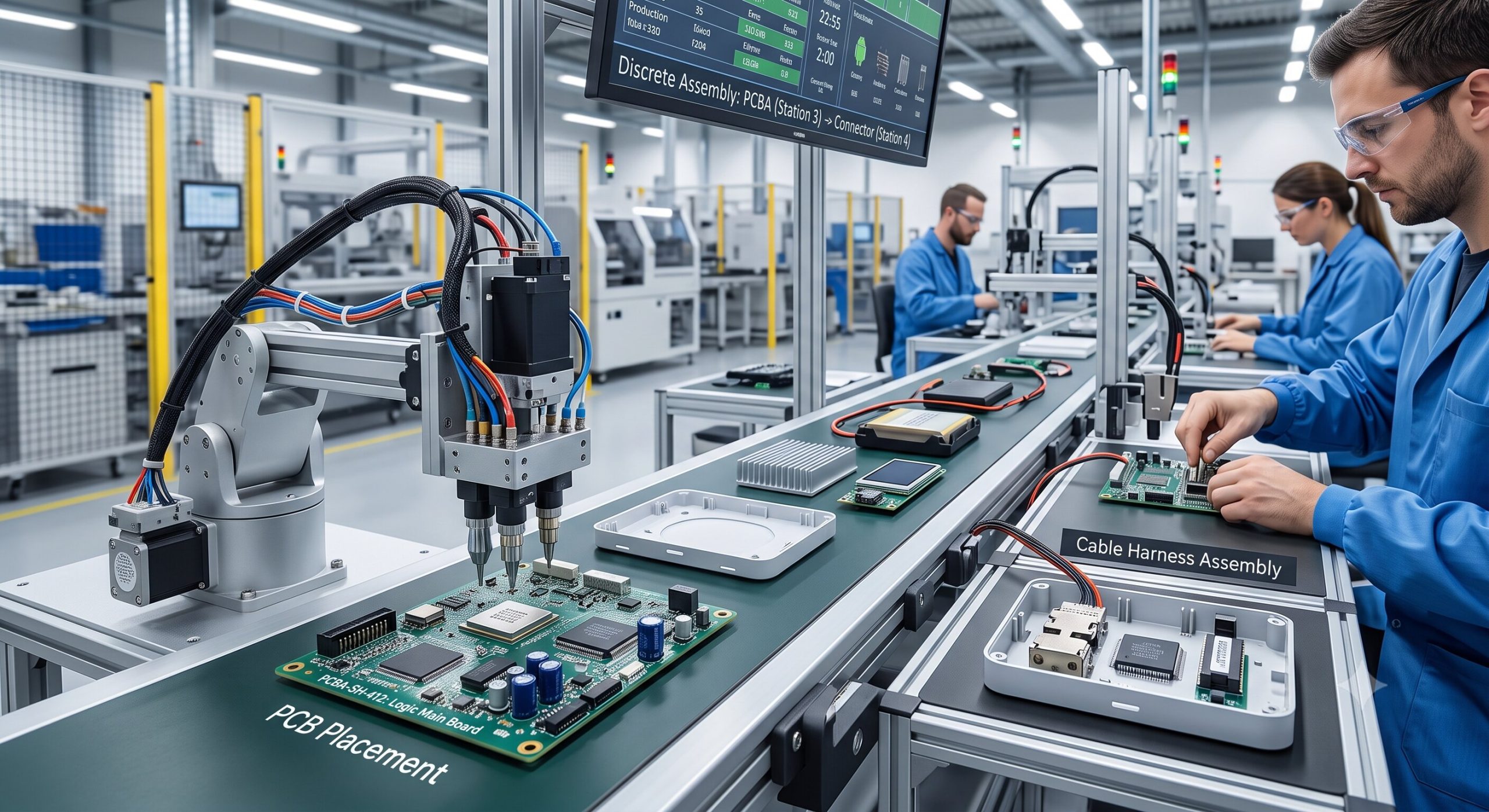
Discrete manufacturing is characterized by the production of distinct, identifiable items. The defining attribute of a discrete manufacturing environment is that the end product can be touched, counted, and often disassembled back into its constituent parts. When answering the question of what is discrete manufacturing?, one must look at the assembly of components. It heavily relies on a Bill of Materials (BOM), which lists the exact quantities of each component required to build the finished good.
In a typical discrete manufacturing workflow, raw materials are transformed through fabrication, stamping, or machining into parts, which are then assembled. Because the output is measured in units (e.g., 100 smartphones, 50 bicycles), the operational focus leans heavily toward parts management, component tracking, and assembly line efficiency.
What is Process Manufacturing?
On the opposite end of the spectrum lies process manufacturing. Instead of assembling parts, process manufacturing involves the blending, boiling, mixing, or chemical transformation of raw ingredients according to manufacturing formulas or production recipes. Once the product is created, it cannot be easily broken down into its original raw materials.
When asking what is process manufacturing?, it is important to distinguish between two main sub-categories: continuous processing (or continuous production) and batch processing. In true continuous production, the manufacturing line runs 24/7 without interruption, often producing massive volumes of a single commodity, such as refined oil or natural gas. Due to the nature of the materials, variable yield in process manufacturing is a constant challenge, requiring sophisticated yield management systems.
What is Batch Manufacturing?
Sitting functionally between discrete assembly and continuous flow is batch manufacturing. When a company produces items in small batches or large, discrete runs of formulated products, they are utilizing this method. So, what is batch manufacturing? It is a technique where products are created in specific, quantified groups (batches) undergoing a step-by-step process. Once a batch completes one stage of the manufacturing processes, the entire batch moves to the next.
This method is highly prevalent in food and beverage, pharmaceuticals, and specialty chemicals. A crucial element in this sector is the batch manufacturing record (BMR). To understand what is batch manufacturing record, we must look at regulatory compliance and quality assurance.
Batch Manufacturing Record Definition: A Batch Manufacturing Record (BMR) is a detailed, documented history of a specific batch of product. It guarantees traceability by recording every ingredient used, the exact equipment parameters, operator signatures, and quality control test results for that specific production run.
2. Deep Dive: Discrete vs Process Manufacturing
The juxtaposition of Discrete vs process manufacturing highlights fundamentally different ways of thinking about production, materials, and measurement.
Bill of Materials vs Formula
The most stark contrast lies in how a product is defined. The difference between discrete and process manufacturing begins at the engineering level. Discrete manufacturing uses a Bill of Materials (BOM). A BOM is a hierarchical list of every part required. For a bicycle, the BOM lists two wheels, one frame, one chain, etc.
Conversely, process manufacturing uses manufacturing formulas or production recipes. These define the precise ratios of raw ingredients, instructions for mixing, temperature controls, and reaction times. Here, the focus shifts entirely from parts vs ingredients in manufacturing. You cannot count the individual ingredients in a gallon of paint once it is mixed; you must rely strictly on robust ingredient management and formula management systems prior to the chemical reaction.
Inventory Management and Yield Management
In discrete operations, inventory management is relatively straightforward mathematically: you need exactly four tires to make one car. In process and batch operations, materials can evaporate, spill, or change volume based on environmental factors like humidity. This introduces the concept of variable yield in process manufacturing. Advanced yield management becomes necessary to track expected output versus actual output and adjust future production planning accordingly.
3. Deep Dive: Discrete vs Batch Manufacturing
While discrete and continuous process manufacturing are polar opposites, understanding Discrete vs batch manufacturing requires more nuanced analysis, as they share the concept of finite production runs.
Production Runs and Shop Floor Operations
In discrete manufacturing, a production order might dictate the assembly of 500 laptops. The shop floor operations are optimized to move these distinct units down an assembly line. Each workstation adds a specific component.
In batch production, a company might produce 500 gallons of a specific shampoo. The entire 500 gallons moves as a single entity through mixing tanks, heating vats, and finally to bottling. Manufacturing execution in a batch environment revolves around controlling the parameters of the equipment (temperature, pressure, agitation time) for the entire batch simultaneously.
Manufacturing Quality Control Differences
There are significant manufacturing quality control differences between these methodologies. In discrete operations, quality control often involves visual inspections, dimensional checks, or functional testing of individual units (e.g., does the laptop turn on?).
In batch operations, quality control requires sampling. A small sample is drawn from the batch and tested in a laboratory for viscosity, pH, or chemical composition. If the sample fails, the entire batch may be compromised. This is where the batch manufacturing record becomes vital, as it documents exactly what went wrong and prevents defective batches from reaching the consumer.
4. Real-World Applications and Examples
To fully grasp these concepts, we must examine real-world applications across various industries.
Discrete Manufacturing Examples
Common discrete manufacturing examples include the production of:
- Automobiles: Assembling engines, chassis, and electronics.
- Consumer Electronics: Smartphones, televisions, and computers assembled from distinct microchips and screens.
- Furniture: Desks and chairs assembled from precut wood and metal fasteners.
- Machinery: Industrial equipment built from thousands of individual machined parts.
Process Manufacturing Examples
Typical process manufacturing examples that rely heavily on continuous production include:
- Petrochemicals: Oil refineries running continuously to produce gasoline and lubricants.
- Paper Processing: The continuous transformation of wood pulp into large rolls of paper.
- Water Treatment: Continuous flow of water through chemical treatment facilities.
Batch Manufacturing Examples
When looking for batch manufacturing examples, we often find industries requiring high flexibility and strict hygiene or compliance standards:
- Pharmaceuticals: Producing specific lots of vaccines or medications with a stringent batch manufacturing record.
- Food and Beverage: Brewing a specific seasonal beer or baking a daily quota of bread.
- Cosmetics: Formulating batches of lotions or perfumes based on strict production recipes.
5. The Crucial Role of Software: Manufacturing ERP
Regardless of the methodology employed, attempting to manage modern manufacturing operations with spreadsheets or legacy systems is a recipe for disaster. This is where a robust Manufacturing ERP (Enterprise Resource Planning) system comes into play. However, because the fundamental workflows differ so drastically, generic ERPs often fail. Businesses must seek out industry-specific ERP solutions.
ERP for Discrete Manufacturing
A dedicated Discrete manufacturing ERP is engineered to handle complex Bill of Materials (BOM) structures, sometimes reaching dozens of levels deep. When searching for the best ERP for discrete manufacturing, companies prioritize features such as:
- Advanced parts management and serial number tracking.
- Routing optimization for complex assembly lines.
- Integration with CAD (Computer-Aided Design) software.
- Precise production planning based on component lead times.
ERP for Process Manufacturing
A Process manufacturing ERP looks very different. The focus shifts toward formula management and regulatory compliance. The best ERP for process manufacturing will excel at handling unit of measure conversions (e.g., buying raw materials in pounds, storing in gallons, and selling in fluid ounces).
For example, an ERP for chemical manufacturing must inherently understand hazard classifications, by-products, and co-products generated during chemical reactions. It must gracefully handle variable yield in process manufacturing.
Batch Manufacturing Software and ERP
A sophisticated Batch manufacturing ERP bridges certain gaps but focuses heavily on lot traceability and batch control. Excellent batch manufacturing software is critical for generating and archiving the electronic batch manufacturing record.
If you are evaluating an ERP software for food manufacturing, it must include robust expiration date tracking, forward and backward lot traceability (to manage recalls), and integrated manufacturing quality control differences specific to food safety (like HACCP compliance). The best ERP for batch manufacturing will seamlessly integrate these compliance features directly into the shop floor operations.
6. Production Planning and Manufacturing Automation
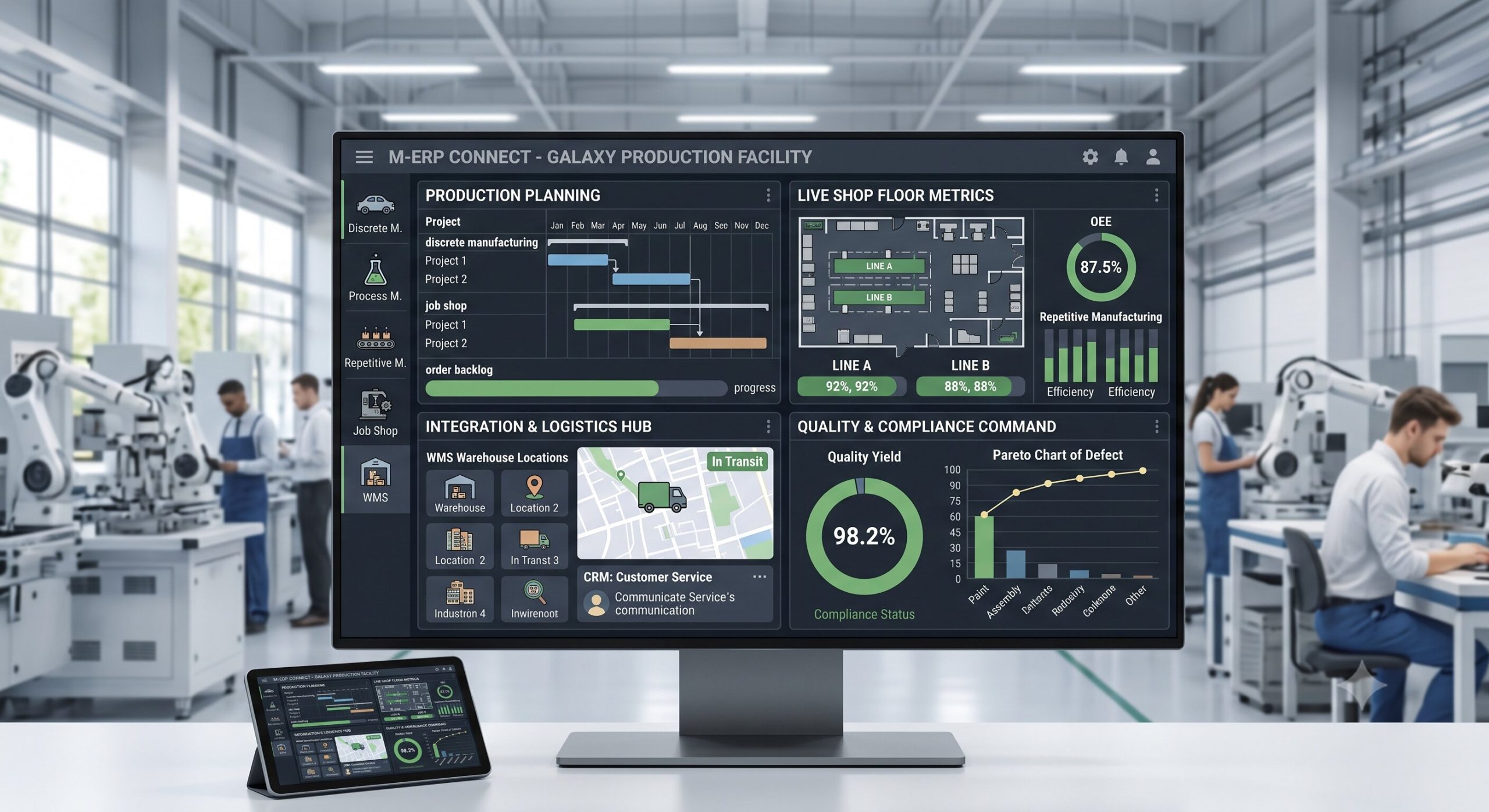
The convergence of physical manufacturing and digital technology—often referred to as Industry 4.0—relies heavily on advanced manufacturing software. Beyond basic ERPs, companies are investing in specialized manufacturing management software and production management software to drive efficiency.
Optimizing Production Planning for Manufacturers
Effective production planning for manufacturers dictates that the right materials arrive at the right time to satisfy the production runs schedule. In discrete environments, manufacturing planning software utilizes Material Requirements Planning (MRP) to ensure every screw and microchip is available. In batch environments, planning software must consider tank capacities, cleaning times between batches, and ingredient shelf-life.
The Drive Toward Manufacturing Automation
Manufacturing automation is reshaping both paradigms. In discrete settings, automation takes the form of robotic arms assembling parts with extreme precision. In process and batch settings, automation involves interconnected sensors (IoT) constantly monitoring fluid temperatures, adjusting valves in real-time, and feeding data back into the manufacturing execution system.
By conducting a thorough manufacturing software comparison, factory leaders can determine which platforms offer the best integration with their specific automation hardware, ensuring a seamless flow of data from the shop floor to the executive dashboard.
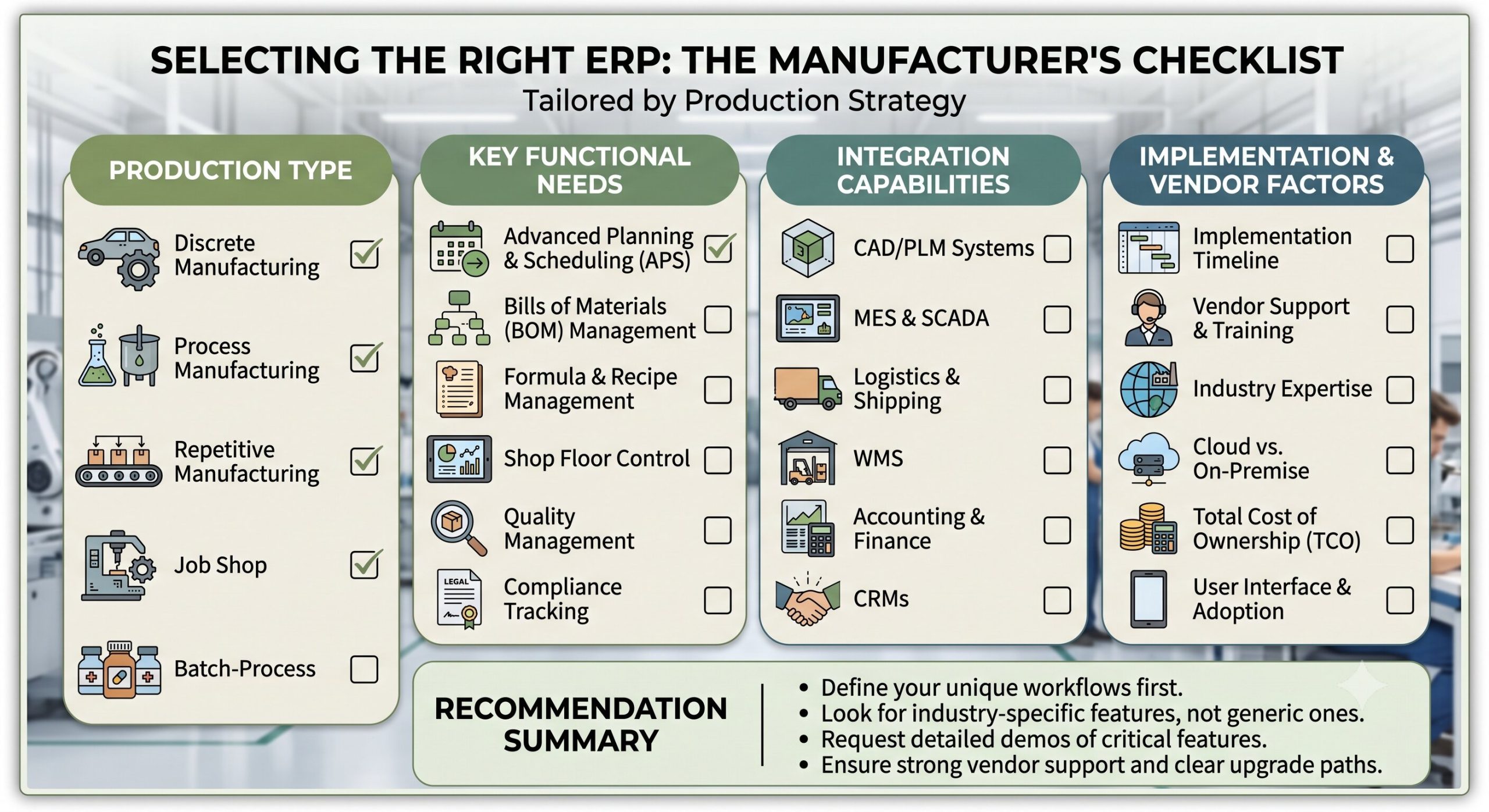
7. Key Considerations When Choosing an ERP
When selecting ERP for manufacturers, the decision committee must deeply analyze their core processes. A common mistake is a batch manufacturer attempting to adapt a discrete-focused ERP. They will constantly struggle with forcing a Bill of Materials (BOM) to act like a recipe, leading to inaccurate costing and inventory nightmares.
- Evaluate Core Capabilities: Does the software natively support ingredient management or just parts management?
- Assess Traceability: Can the system generate a compliant, unalterable batch manufacturing record with a single click?
- Analyze Yield Management: Does the batch manufacturing ERP software automatically account for evaporation or scrap during continuous processing?
- Review Quality Modules: Are the quality control features embedded within the production workflow, or are they an afterthought?
8. Conclusion: Aligning Strategy with Technology
The debate of Batch manufacturing vs discrete manufacturing is not about which method is objectively superior; it is about which method is fundamentally required by the product being created. You cannot assemble a liquid pharmaceutical using discrete methods, nor can you pour liquid plastic and metal into a vat to brew a smartphone.
Understanding the deep operational differences—from Bill of materials vs formula to parts vs ingredients in manufacturing—is the first step toward operational excellence. The next, and arguably more crucial step, is empowering your facility with the correct technology. Whether you require a hyper-precise Discrete manufacturing ERP to manage a vast network of assembly components, or a stringent Batch manufacturing ERP to maintain impeccable batch manufacturing records and FDA compliance, the right software is the linchpin of modern industrial success.
As manufacturing automation continues to evolve, the lines between these methodologies may blur—with hybrid environments becoming more common. However, the foundational principles of production planning, stringent inventory management, and relentless quality control will always remain the cornerstones of profitable manufacturing operations.
*Note to editor: The image placeholders above have been styled for placement. Please ensure you update the <img src=””> tags with the final live URLs of the optimized images when publishing.*
Frequently Asked Questions (FAQs)
1. What is the main difference between discrete and process manufacturing?
The primary difference between discrete and process manufacturing is how the product is built. Discrete manufacturing involves assembling distinct, countable parts (like electronics or cars) that can usually be taken apart. Process manufacturing involves mixing ingredients according to production recipes to create goods (like chemicals or food) that cannot be easily disassembled into their original components.
2. What is a batch manufacturing record?
A batch manufacturing record (BMR) is a highly detailed document that traces the entire production lifecycle of a specific batch of goods. To answer what is batch manufacturing record definition-wise: it is the definitive proof of compliance, detailing exact ingredient quantities, equipment parameters, and quality control test results for a specific production run.
3. How do Bill of Materials (BOM) differ from manufacturing formulas?
When comparing a Bill of Materials vs formula, a BOM is a strict list of distinct components and quantities needed for discrete manufacturing (e.g., 2 wheels, 1 frame). A manufacturing formula (or recipe) is used in batch manufacturing and process manufacturing to define the chemical or physical mixture of ingredients, accounting for things like variable yield and evaporation.
4. What are some common batch manufacturing examples?
Some of the most common batch manufacturing examples include the pharmaceutical industry (producing specific lots of vaccines), food and beverage (brewing seasonal beers or baking goods), and cosmetics (creating specific formulations of lotions). In all these scenarios, a company produces items in small batches rather than running a continuous 24/7 line.
5. Why is specialized batch manufacturing software necessary?
Generic ERP systems often fail to manage the nuances of batch processes. A dedicated batch manufacturing ERP software is essential because it is specifically designed to handle ingredient management, complex quality control sampling, expiration dates, and the automated generation of the batch manufacturing record. It perfectly aligns with the unique manufacturing operations and compliance needs of batch producers.