TL;DR: The 2026 SCM Strategy
- The Goal: Moving from "tracking" to "predicting" using AI-driven orchestration.
- The Shift: 2026 is the year of "Agentic AI"—software that doesn't just show data but suggests (and takes) corrective actions.
- The ROI: Most businesses see a full payback within the first 18 months through a massive reduction in "dead stock" and faster fulfillment.
The Risk: Sticking to spreadsheets in 2026 costs more in manual errors and lost customers than the software investment itself.
How Much Does Supply Chain Management Software Cost in 2026?
Imagine this: It’s 11:00 PM. Your biggest client just placed a bulk order, but your inventory screen is lagging. By the time it refreshes, you realize the "available" stock was sold two hours ago on another channel.
Result? A cancelled order, a frustrated customer, and another "fire drill" for your operations team.
In 2026, supply chain volatility isn't a "possibility"—it's a daily reality. Global shipping routes are shifting, fuel prices are unpredictable, and customer expectations for "next-day delivery" have moved from the city to the village. Whether you are a manufacturer in Pune or a D2C brand in Bangalore, the question isn't just about the software; it's about survival.
Many business owners ask, "How much does supply chain management software cost?" but the real question you should be asking is: "How much am I willing to lose by not having it?" If you are still using manual spreadsheets, you are likely leaking profits through "invisible leaks"—inventory bloat, data silos, and compliance fines. In 2026, SCM software has evolved from a simple digital ledger into an intelligent orchestration engine driven by Agentic AI.
In this exhaustive guide, we are stripping away the corporate jargon. We will deep-dive into the actual supply chain management software cost structure, comparing SaaS vs. Custom builds, uncovering hidden implementation fees, and showing you the real-world ROI math that helps Indian brands scale globally.
The "Invisible Leak" in Your Warehouse: What Is Your Legacy System Really Costing You?
Imagine this: It’s 11:00 PM. Your biggest client just placed a bulk order, but your inventory screen is lagging. By the time it refreshes, you realize the "available" stock was sold two hours ago on another channel.
Result? A cancelled order, a frustrated customer, and another "fire drill" for your operations team.
In 2026, supply chain volatility isn't a "possibility"—it's a daily reality. Global shipping routes are shifting, fuel prices are unpredictable, and customer expectations for "next-day delivery" have moved from the city to the village. Whether you are a manufacturer in Pune or a D2C brand in Bangalore, the question isn't whether you need Supply Chain Management Software in 2026; it's how much you are willing to lose by not having it.
Software pricing is complex and depends entirely on your business scale, complexity, and specific pain points. In this guide, we’re stripping away the jargon to give you the strategic factors, hidden costs, and the ROI math you need to make a smart decision.
What is Supply Chain Management Software in 2026?
At its core, SCM software is the "nervous system" of your business. It connects every dot—from raw material procurement and warehouse storage to the final "out-for-delivery" notification. However, the definition has changed.
In 2026, this software has evolved into an intelligent orchestration engine. It’s no longer just a digital ledger or a simple database; it’s an AI-driven system that senses market pulses.
The 2026 Tech Stack Modules:
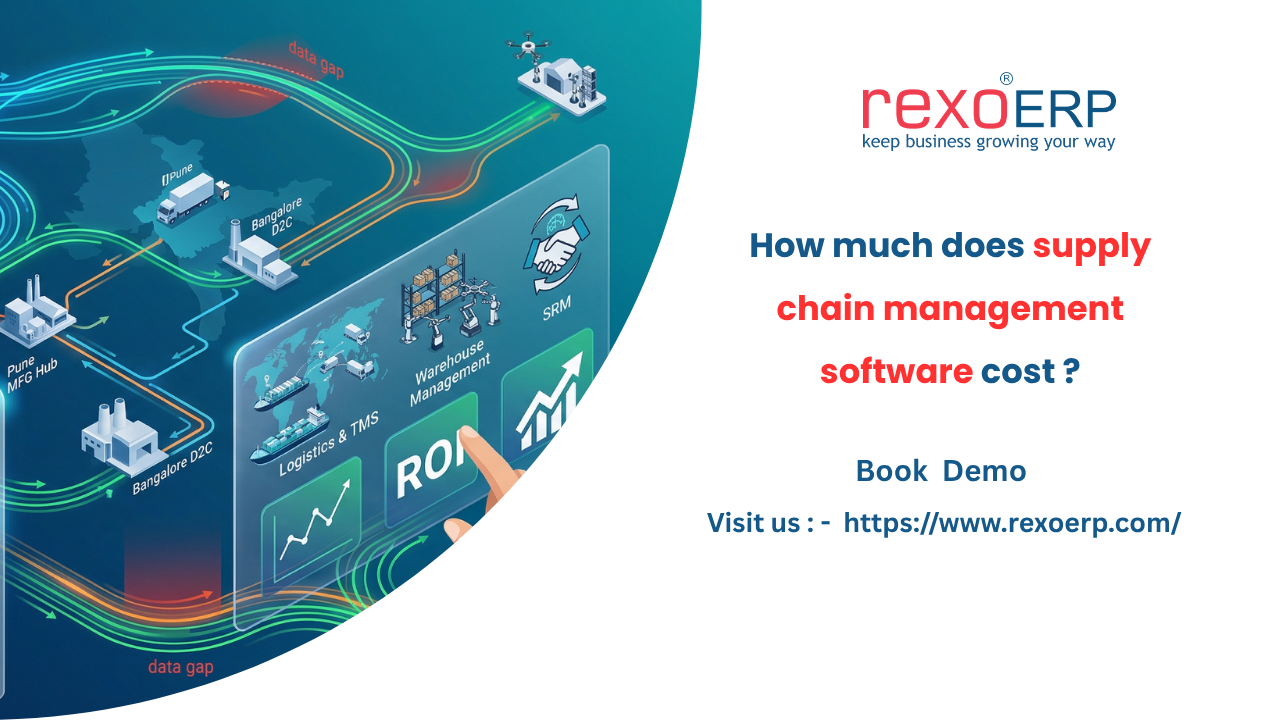
- Demand Sensing & Forecasting: - Using machine learning to analyze social media trends, weather patterns, and historical sales to predict what you’ll need next month.
- Inventory Optimization: - Multi-echelon inventory management that tells you exactly how much stock to keep at each hub to minimize "dead capital."
- Logistics & TMS (Transportation Management): - Dynamic route planning that adjusts in real-time based on traffic, weather, or port congestion.
- Warehouse Management (WMS): - Integrating with robotics and IoT sensors to track every pallet's movement without human intervention.
- Supplier Relationship Management (SRM):- A digital bridge that gives your vendors visibility into your production schedule so they never send raw materials late.
Why It Matters: The Real Cost of "Manual" Operations
If you believe hiring a professional to set up your software is a "expense," try figuring out how much it costs to do things by hand. In India, where profit margins are generally low, these leaks can kill a business:
1. The "Safety Net" Trap (Inventory Bloat)
Because they don't believe their data, a lot of manufacturers order 20–30% more raw materials than they need to "be safe." That's a lot of money sitting in a warehouse, getting dusty instead of earning interest..
2. The Data Silo Penalty
When Sales uses Excel, Production uses a whiteboard, and Logistics uses a different software, mistakes are sure to happen. If you make 1% of your orders wrong, you could lose 10% of your customers.
3. Regulatory & Compliance Risks
Because of the new rules of Green Logistics and Carbon Credit Tracking that will go into effect in 2026, reporting by hand is no longer a possibility. If you can't show how much carbon your supply chain produces, you might get big fines or lose contracts to export goods to other countries.
Deep Dive: How SCM Software Investment is Structured
When evaluating Supply Chain Management Software price, you aren't just looking at a sticker. You are looking at a deployment philosophy.
Path A: The Cloud-Native SaaS Model (Agility First)
This is the "pay-as-you-go" approach. It is hosted on secure servers (like AWS or Azure) and managed by the vendor.
- Pros: Lower entry cost, zero server maintenance, and weekly feature updates.
- Best For: Fast-growing D2C brands, SMEs, and distributors who need to go live in weeks, not months.
Path B: The Custom-Built Architecture (Ownership First)
For large-scale manufacturers with proprietary workflows. This is a system built specifically for your "secret sauce."
- Pros: No recurring per-user fees, total control over data security, and deep integration with specialized machinery.
- Best For: Large industrial plants, pharmaceutical companies with strict cold-chain requirements, and companies with 10+ global locations.
The 5 Pillars of a 2026 SCM Quote
When you request a quote, your partner will analyze these five pillars to determine the scope:
1. Integration Complexity (The "Talk" Factor)
The software doesn't live on an island. It needs to talk to your accounting tool (like Tally), your CRM, your website, and your 3PL partners. The more "languages" it needs to speak, the more complex the setup.
2. User Roles & Access Nodes
Are there 5 people using the system in one office, or 500 workers across 10 warehouses using handheld scanners? The scale of access determines the server load and license structure.
3. Data Migration & Hygiene
Most businesses have "dirty data"—duplicate entries, wrong SKU codes, and missing supplier info. Cleaning this data and migrating it from old spreadsheets is a critical (and often the most time-consuming) part of the investment.
4. AI & Automation Depth
Do you want "Basic AI" (simple alerts) or "Agentic AI" (autonomous decision-making)? High-level automation that can re-order stock without human approval requires more robust testing and logic building.
5. Security & Disaster Recovery
In 2026, cyber-attacks on supply chains are common. Investing in Zero-Trust Architecture and real-time data backups is a non-negotiable part of the modern quote.
The "Hidden" Costs: What Vendors Don't Always Mention
To ensure your project stays on budget, you must account for these:
- Change Management: Your staff has been doing things "their way" for 20 years. Training them to use new tech isn't just a 2-hour meeting; it’s a culture shift that requires dedicated time.
- Hyper-Care Support: The first 30 days after "Go-Live" are critical. You will need a dedicated support team to handle the "How do I do this?" questions.
- Hardware Upgrades: Does your warehouse have stable Wi-Fi? Do your workers need ruggedized tablets or barcode scanners? This hardware cost is often separate from the software.
- API Maintenance: Third-party services (like courier tracking) often update their systems. Your SCM needs occasional "tuning" to keep these connections seamless.
Industry-Specific Requirements (2026 Trends)
For Food & Beverage / Pharma:
You need Batch Tracking and Expiry Management. The software should automatically "flag" stock that is 30 days from expiring and suggest a discount or a priority shipment.
For Electronics & High-Value Goods:
Serial Number Tracking is vital. If a component is recalled, you should be able to identify exactly which customers received that specific batch in seconds.
For E-commerce & D2C:
Omnichannel Synchronization is the priority. If a product sells on Amazon, the stock level on your Shopify store and your physical warehouse must update in less than 2 seconds.
Use Case: Transforming a Delhi-Based Distributor
The Challenge: A distributor with 3,000 SKUs and 3 warehouses was facing "Ghost Inventory"—items that showed up on the computer but weren't on the shelf. The Solution: A custom SCM build with IoT-enabled shelf sensors and a mobile-first WMS. The Outcome:
- Inventory Accuracy: Improved from 65% to 99.4%.
- Labor Efficiency: Warehouse staff saved 2 hours per day by following "Optimized Pick Paths" generated by the software.
- Financial Impact: The reduction in lost sales and over-stocking paid for the entire system in under 15 months.
How to Choose the Right SCM Solution for Your Business
- Define Your "Non-Negotiables": What are the 3 things the software must do?
- Request a "Proof of Concept" (POC): Don't just watch a video. Ask the vendor to show how the software handles your specific data.
- Check Local Support: In India, things move fast. You need a partner who understands local GST laws, e-way bill integrations, and local logistics quirks.
- Security Audit: Ask about their data encryption standards. Your supply chain data is your most valuable secret.
Why Partner With Us for Your SCM Journey?
We don't just build software; we solve business bottlenecks. Our 2026-ready SCM solutions are built to be:
- Human-Centric: Designed so your warehouse team can use it with zero technical background.
- Predictive, Not Reactive: Get alerts before a stockout happens, not after.
- Value-Driven: We focus on the high-impact modules first to ensure you see ROI as quickly as possible.
FAQs
Why is there no "fixed price" for SCM software?Every supply chain is unique. Pricing depends on your number of users, the complexity of your logistics, and whether you need custom integrations with your existing ERP or Tally.
Can SCM software integrate with my existing Tally or SAP?Yes. In 2026, professional SCM systems use API-first architectures, allowing them to sync seamlessly with your accounting and legacy platforms without losing data.
What is "Agentic AI" in SCM?Unlike traditional AI that just shows you a chart, Agentic AI can take action—such as automatically re-routing a shipment if it detects a port delay or placing a purchase order when stock hits a certain limit.
How long does implementation take?A basic setup can take 4–6 weeks, while a fully customized enterprise-grade platform typically requires 6–9 months to design, build, and deploy correctly across multiple locations.
Is the investment worth it for a small manufacturer?Absolutely. Even a basic system can save you lakhs by reducing waste, preventing over-stocking, and ensuring you never miss a high-value order due to data errors.